Rates Starting at $40
Care Coordinator

For new clients, your first session with one of our counselors can be only $40. Don’t miss out on this deal!
Contact our office for more information!
Use the form on the right to contact us.
123 Street Avenue, City Town, 99999
(123) 555-6789
email@address.com
You can set your address, phone number, email and site description in the settings tab.
Link to read me page with more information.
For new clients, your first session with one of our counselors can be only $40. Don’t miss out on this deal!
Contact our office for more information!
Our Children’s Social Skills group will take place on Mondays from 5-6pm at the Martin Counseling office. In this group, your child can learn how to have a conversation with others and understand what friendship means. From participating in this group, your child can gain confidence in their ability to interact and solve problems.
Contact our office for more information!
There is NO COST for attending this meeting.
To reserve your place at this event please RSVP by filling out this simple form.
https://forms.gle/BQGmT7dhKjhX8FQ7A
THE MEETING TIME IS 11:30 AM TO 1:30 PM.
NETWORKING 11:30 AM TO 1:00pm.
Hosted by:
Katy Spiritual Care Network
David Bueno Martin from Martin Counseling
Eric Ayles from Starlite Recovery
Light lunch provided by Rose Johnson from New Dimensions Day Treatment Centers
For any questions, please contact Martin Counseling’s office at 713-489-5473 or email: Info@HoustonLPC.com
It is time for Mental Health Advocacy Day at the Texas State Capitol in Austin. LET YOUR VOICE BE HEARD! NAMI Greater Houston invites you, your organization and/or group to join us for a day of advocacy, networking and camaraderie on Wednesday, February 1, 2023.
Advocacy is essential to improving access and availability of mental health care across Texas. Advocates who are able to effectively share their stories of mental illness and recovery can help to shape the policies that determine the quality of care provided to those most in need. Simply, advocacy is one of the best ways to ensure that every Texan living with a mental illness is given the opportunity for recovery.
We are excited to have so many folks registering for the lunch, rally, legislative visits and the FREE bus ride from the Houston area to Austin.
Be sure to fill out this simple form to hold your spot!
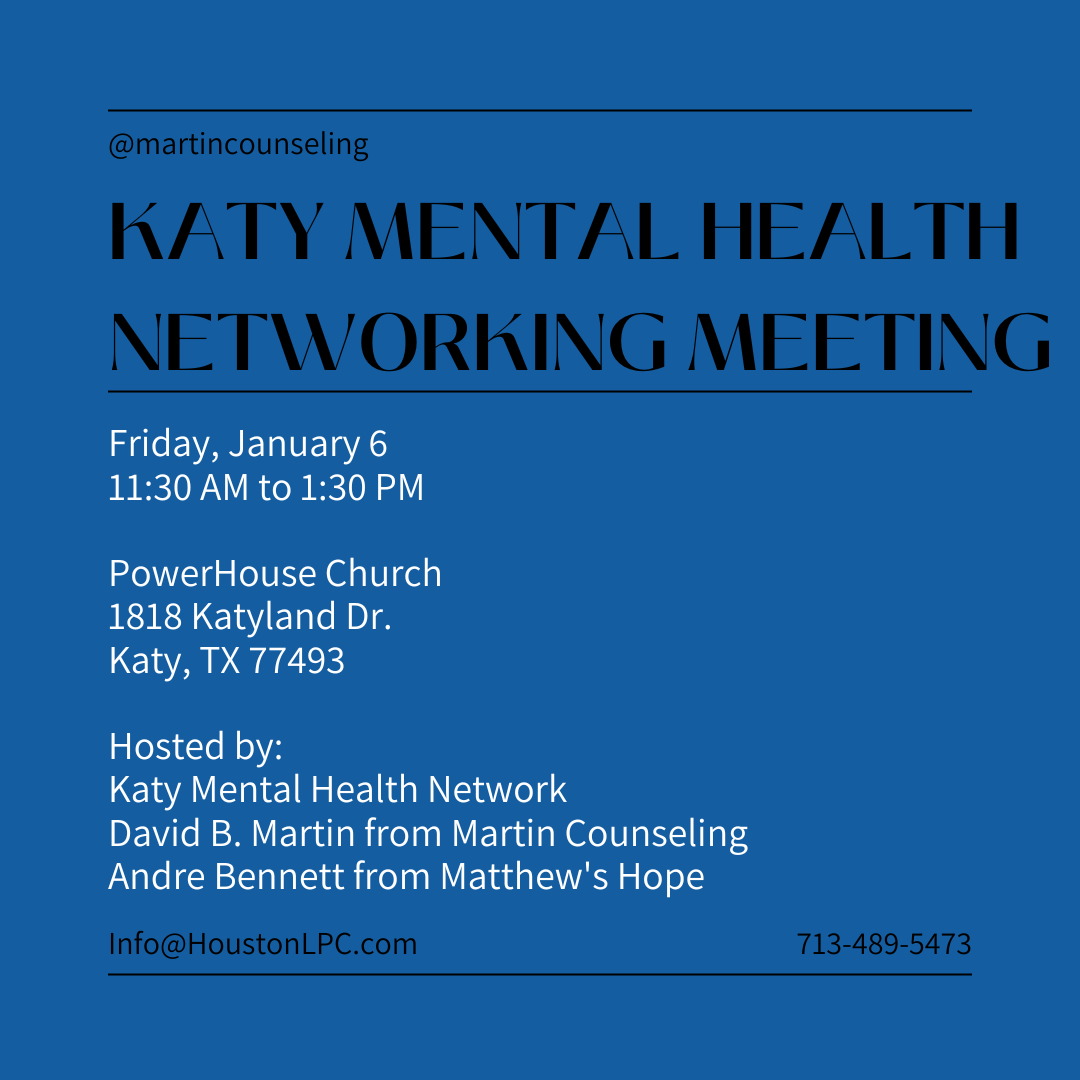
PowerHouse Church in Katy
There is NO COST for attending this meeting.
To reserve your place at this event please RSVP by filling out this simple form.
https://forms.gle/htu969wKv6P4uX3f6
THE MEETING TIME IS 11:30 AM TO 1:30 PM
Hosted by:
Katy Mental Health Network
David Bueno Martin from Martin Counseling
Brooke Martin from Acadia Healthcare
For any questions, please contact Martin Counseling’s office at 713-489-5473 or email: Info@HoustonLPC.com
This blog is presented by Yamid Montalvo, LPC. For more information, please visit Martin Counseling.
Classic Symptoms
People with schizophrenia suffer from many symptoms; these are classified as positive and negative. Some positive symptoms include delusions and hallucinations, which involve adding irrational behaviors caused by hearing or seeing things that are not real. While negative symptoms schizophrenia patients are usually based on the loss of feelings, emotions and thrive to accomplish anything. Depending on the severity of the patient’s illness, many symptoms are shown at the same time.
Positive Symptoms
Delusions are one of the most common positive symptoms. Delusions can cause schizophrenic people to believe incredible stories and make them lose touch with reality. According to Hockenbury, and Hockenbury (2000) in the book Psychology, “schizophrenic delusions are usually bizarre and far-fetched. The person believes that secret agents are poisoning his food, or that the next-door neighbors are actually aliens.” These symptoms affect people’s relationships and significantly decrease their social skills. One specific type of delusion is called delusion of grandeur; this irrational belief causes people to think that they are really important or somebody who is famous. (Hockenbury et al., 2000, p. 584) This effect usually makes people stop taking their medications and causes them to lose control of their illness and relapse. Another positive symptom is the presence of hallucinations; these are sensory perceptions in the absence of external stimulation. There can be auditory hallucinations, which are the most common, tactile hallucinations, and visual hallucinations (Greene, Nevid, & Rathus, 2014, p. 412). Many schizophrenic patients start hearing voices inside their heads that may induce them to do things that in regular circumstances would not do. Some of them may experience something called command hallucination, in which voices instruct them to harm others or commit a crime (Greene et al, 2014, p. 413). Even though it is normal for most people to start some sorts of conversation with themselves, or do things with the assessment of them speaking out loud, to schizophrenics it is different. They may have a silent self-talk caused by their auditory hallucinations (Greene et al, 2014, p. 413). In contrast with all these symptoms, negative symptoms remove several individual’s emotions and affect his or her state of mind.
Negative Symptoms
Negative symptoms affect daily functions and include a loss of motivation, loss of pleasure in normally pleasant activities, social withdrawal or isolation (Greene et al, 2014, p. 408). One behavior that can significantly change people’s behavior is called catatonic behavior. People in a catatonic state may exhibit off gestures and bizarre facial expressions or become unresponsive (Greene et al., 2014, 415). All these changes in personality are presented in most people suffering from schizophrenia, but there are several other physical expressions that are easily identified as well. Also schizophrenics may suffer a loss of emotional expressions, which is called flat affect. Schizophrenics who present signs of flat affect usually suffer from an absence of emotional expression in the face and voice. They may not experience a normal range of emotional response to people and events or they may speak in one tone of voice (Greene et al., 2014, 414). People with schizophrenia may also show signs of confusion about themselves. They sometimes even lose sense of what is really part of their personality and what is not. Schizophrenics may fail to recognize themselves as unique individuals and be unclear about how much of what they experience is part of themselves (Greene et al., 2014, 414). They tend to show significant impairment in interpersonal relationships. They withdraw from social interactions and become absorbed in private thoughts and fantasies (Greene et al., 2014, 415). One of the most complicated effects of schizophrenia is called inappropriate affect. This causes schizophrenics to lose the ability to react appropriately to different circumstances. For example, a person with schizophrenia may cry over food being dropped on the floor, while laughing hysterically at the death of some relative or friend (Lefton & Linda, 2003, p. 550).
Social Consequences
Schizophrenics suffer from social impairment that makes them struggle in life. In severe cases they would not be able to survive on their own. In aspects such as self-care, schizophrenics are not able to maintain their personal hygiene, and they are unable to feed themselves (Janca, Kastrup, Katsching et al, 1996). With occupational performances, schizophrenics are unable to find a paying job, go to school and get good grades or even do regular household chores. Also, schizophrenics have difficulties maintaining strong relationships with other family members such as spouses, parents, children, or other relatives (Janca et al, 1996). Finally, functioning in society can be very difficult. Schizophrenics have difficulty showing appropriate behavior or are unable to communicate properly with others or in social activities (Janca et al, 1996). Social stigma is another common problem among people with schizophrenia. As it is explained by Barbato in “Schizophrenia and Public Health,” social stigma is related to the mistreatment of ill people with exaggeration. As he says “ Various adverse consequences may arise from the stigmatization process: use of pejorative language, barriers to housing or employment or restricted access to social services.” This can explain the burden that some schizophrenics have to deal with once they are diagnosed with the disease and many times families are torn apart with the news. Another negative aspect that schizophrenics have to deal with is the medical care. Usually the person suffering from schizophrenia needs to have someone taking care of him or her at all times. This represents many more changes in the family’s lifestyle. The economic burden is mostly the main concern when it comes to people with lower income; also there is the loss of productivity of a family unit. The family’s emotional reaction, sometimes other family members may have feelings of fear, loss of hope, and guilt. The stress related to coping with the irrational behavior of the schizophrenic family member is another important aspect of this disease. It often breaks a regular cycle that the family had established before the illness. Most of them have routine lives that are disrupted abruptly and many cannot cope with the stress (Barbato, n.d., p. 14).
Possible Causes
Even though it is unknown the real cause of schizophrenia, there has been enough research to narrow down the possible reasons. One possibility is genetic predisposition; another possibility is psychological trauma during childhood and finally there is other possibility that involves some environmental factors. Even though there is not enough research to demonstrate which one is the most precise explanation, the mix of those three options present a strong hypothesis of how schizophrenia is acquired. Even though there has not been a lot of research, there is a theory that links flu viruses in pregnancy to the development of schizophrenia in newborns. As Lefton (2003) explains in his book “The development of schizophrenia does not occur through any simple mechanism–both biology and environment are involved”(556).
Genetic Predisposition
It is almost certain that the closer the genetic relationship between schizophrenic patients and their family members, the greater the likelihood that their relatives will also have schizophrenia. The first-degree relatives are most at risk. Research showed that monozygotic twins have 48 percent of probabilities of having the illness, while offspring of dual mating of schizophrenic parents have 46 percent. For spouses of patients the percentage is really low, showing a 2 percent probability. Uncles/Aunts, nephews/nieces, grandchildren, and half siblings have around 2-6 percent risk of becoming schizophrenic (Greene et al, 2014, p. 417). There is a clear sign that overactivity of the neurotransmitter; dopamine is involved in the cause of schizophrenia (Greene et al, 2014, p. 419).
Environmental Factors
There is another approach called social learning, where people learn to imitate schizophrenic behaviors from their parents and other key figures in their environment (Smith, 1998, p.580; Watt, Grubb et al, 1982). The behavioral approach claims that if a child is part of a family where the parents fight a lot or one of them is an alcoholic there is a greater chance of becoming schizophrenic (Lefton et al, 2003, p. 555). Mainly a hostile relationship between family members and lack of appropriate communication may be crucial to the development of schizophrenia (Lefton et al, 2003, p. 555). In any way a hostile environment can have several negative consequences on a child’s personality. If there is a genetic predisposition, it is likely that the child could develop schizophrenia.
References
Barbato, A. (n.d.). Schizophrenia and Public Health. Retrieved from http://www.who.int/en/
Greene, B., Nevid, J., & Rathus, S. (2014). Abnormal Psychology in a Changing World. Pearson Education, Inc.
Hockenbury, D., Hockenbury, S. (2000). Psychology. New York, NY: Worth Publishers.
Janca, A., Kastrup, M. Katsching, H., Lopez Ibor jr. J.J., Mezzich, J. E., Santirius, N. (1996). Social Psychiatry and Psychiatric Epidemology. The world Health Organization.
Lefton, L., Linda, B. (2003). Psychology. Boston, MA: Pearson Education.
Smith, B. (1998). Psychology: Science & Understanding. United States: The Mcgraw-hill Companies.
Watt, N. F., Grubb, T.W., & Erlenmeyer-Kimling, L. (1982). Journal of Experimental Psychology, 3, 1-4.
PowerHouse Church in Katy
There is NO COST for attending this meeting.
To reserve your place at this event please RSVP by filling out this simple form.
https://forms.gle/HxrEKftvFGSeR8nD8
THE MEETING TIME IS 11:30 AM TO 1:30 PM
Hosted by:
Katy Mental Health Network
David Bueno Martin from Martin Counseling
Light lunch provided by Andre Bennett from Matthew's Hope
For any questions, please contact Martin Counseling’s office at 713-489-5473 or email: Info@HoustonLPC.com
“People are not passive recipients of trauma; they respond to trauma in the best way that they know how”.
– Michael White, 2007, Toronto
Therapy with traumatic experiences requires a skillful balance between re-visiting without re-traumatizing, re-living resiliency without the powerlessness, re-connecting with the body without slipping into fight, flight or freeze. This skillful balance can be better achieved with knowledges of narrative practice concepts and maps, understandings of the socio-cultural factors shaping the meaning of the event, and the brain-body ramifications of having been faced with an integrity threatening incident.
In this workshop Marie-Nathalie and Jim will present foundational narrative practice concepts that reconnect people with their preferred identities and examine when narrative practices benefit from additional ideas to address non-verbal ties to embodied reactions.
New findings in Interpersonal neurobiology (IPNB) and the fields of embodiment offer rich possibilities of expanding our narrative practices in ways that can empower people in more effective and lasting ways. Pausing foundational narrative conversations to insert moments relying on IPNB knowledges and embodiment approaches can sometimes re-energize the re-authoring of preferred identities, and lead to more sustainable changes.
For more info or to register https://jstinstitute.com/events/
This blog is presented by Yamid Montalvo, LPC. For more information, please visit Martin Counseling .
Phobias are an extreme fear of regular situations or objects. There is a social anxiety disorder, specific phobias, and agoraphobia. The causes for phobias are associated with genetic factors, psychological factors, and social and sociocultural factors. The treatment for phobias is often through the use of benzodiazepines and antidepressants. Also, there are cognitive-behavioral treatments such as exposure therapy, systematic desensitization, cognitive restructuring, and modeling therapy.
Panic disorders involve constant panic attacks for one month or more. The causes of panic disorders are biological factors, psychological factors, social factors, and sociocultural factors. The biological treatments for panic disorders are benzodiazepines, antidepressants, and beta-blockers. The cognitive-behavioral treatment for panic disorders often involves teaching the client about self-efficacy, which aims to extinguish the symptoms.
Generalized anxiety disorder (GAD) involves increased levels of anxiety and excessive worry about anything that happens in daily life. The causes of GAD involve biological, psychological, social, and sociocultural factors. The treatment for GAD is usually through the use of antidepressants and benzodiazepines.
Obsessive-compulsive disorders are a combination of anxiety-producing thoughts and compulsions. Obsessions characterize these disorders with contamination, errors, unwarranted impulses, and order. Etc. The causes involve psychological, biological, social, and sociocultural factors. These disorders are treated with antidepressants to increase serotonin levels and behavioral treatments. Some techniques used in behavioral therapies are gradual exposure, flooding, and responsive prevention.
Problem Solving and Behavior Modification
Problem Solving: Make available a variety of response alternatives and increase the probability of selecting the most effective.
5 Stages:
General Orientation:
Accept the problem is a normal part of life and it is possible to cope with it
Recognize problematic situations when they occur
Avoid the tendency to react impulsively or “do nothing”
Problem Definition and Formulation:
Define all aspects in operational terms
Formulate or classify elements of the situation
Define the problem into smaller pieces and switch the problem to a positive perspective
Generation of Alternatives:
Define criteria for an acceptable solution – List your values
Brainstorming:
Criticism is ruled out – Judgment of ideas is held until later
Check for biases
Free-wheeling – the wilder the idea the better
Quantity is wanted – more ideas the better
Combination and improvement are sought – Two or more ideas can be joined to create a better idea
Overcoming Obstacles:
Restructure the problem or manipulate it to look at it from a different perspective
Think outside the box
Overcome “functional fixedness” – Idea that all things work in the same way
Extra Tips:
Imagine the end goal and work backward
Analog strategy: Identify similar previous problems and consider how it was solved
Take a break: seek that “aha” moment
Decision Making:
Descriptive Model: Attempt to describe and predict the way in which individuals typically make decisions
Normative Model: Involves the specification of rules which one may follow in order to optimize the quality of decisions
Utility: Value of each action + likelihood of achieving the goal
Verification: After choosing a course of action, assess the outcome to allow for self-correction
Feedback
Test-Operate Test-Exit (TOTE) – Outcome is congruent or incongruent: if desired outcome is congruent, subject stops looking for options. If desired outcome is incongruent, subject keeps looking for options.
D’Zurilla T., Goldfried, M. R. (1971). Problem solving and behavior modification. Journal of Abnormal Psychology, 78 (1), 107-126.
Highly competitive sports are followed and enjoyed by many people around the world. Whether it is football, soccer, basketball, or tennis, there is always a lot of attention put on the players and their performance. Young athletes become famous as soon as they obtain a place in a well-known professional team, regardless of the sport. Most people would think these challenges could only bring growth for the athlete. However, very talented players who obtain the opportunity to debut in great teams or competitions often need to perform more adequately. Some players even face difficulties maintaining their life distractions from interfering with their professional careers.
There have been many examples of this occurrence across different sports worldwide. In the United States, Johnny Manziel was a football quarterback that played exceptionally well during his college career. He was expected to become one of the best players in the NFL, but after he was drafted, he struggled to maintain a high level of performance. Manziel faced different personal problems, which led him to become a free agent and not play in the NFL anymore. Another example of this is Giovanni Dos Santos. He was a soccer player who won the world cup sub 17 in 2006. Also, he was given the most valuable player award for that tournament. Dos Santos was expected to become the next soccer superstar due to his talent and the European top-class team he was playing for. However, he never became a crucial player on the team and ended up being traded a couple of years later. These examples show how more than talent is needed to become the best player in a sport. Professional players need to find a way to deal with stress and anxiety caused by adverse outcomes or results to avoid failing as an athlete.
Stress plays a vital role in sports. Some athletes can suffer from work overload, whether they spend too much time in practice, work at school, or a mixture of the two; it can have serious consequences such as burnout. In a study by De Francisco, Arce, Vílchez, and Vales (2016), four hundred and fifty-three athletes participated to show the effects of burnout in sports. De Francisco et al. (2016) used the Athlete Burnout Questionnaire to measure the participant’s levels of exhaustion. The data suggest that prolonged stress leads to burnout, which turns into physical symptoms such as headaches, negative self-talk, depression, etcetera (De Francisco et al., 2016). These stressors could impair an athlete’s mental and physical ability during a highly stressful situation such as a final or playoffs. Another stressful situation is when an athlete gets injured. Athletes face frustration and devastation from being unable to play due to injury. This also raises stress levels, and athletes often do not realize it. Some do not receive the proper support in times of injury, which affects athletes emotionally.
Coping mechanisms are helpful whenever there are high-stress situations in sports. Young athletes need to learn how to cope with stress and anxiety to succeed during competitions, especially, when they are required to improve their performance at a higher level. Anshel, Williams, and Williams (2000) conducted a study with 649 athletes. They were all involved in highly competitive sports and made them complete the Coping Style in Sports Survey (CSSS). This survey asked the participants about stressors, such as making errors, being criticized by the coach, or experiencing a bad call by the referee (Anshel et al., 2000). The results supported the idea that a strong coping mechanism was of great help to athletes. They argued that an approach or an avoidant coping style could have a better impact on performance than not having a coping strategy. A young athlete starting his or her professional career should acknowledge how important it is to work on ways to deal with stress and anxiety.
Written by: Yamid Montalvo, MA, LPC
Anshel, M. H., Williams, L. T., & Williams, S. M. (2000). Coping Style Following Acute Stress in Competitive Sport. The Journal Of Social Psychology, 140(6), 751-773
De Francisco, C., Arce, C., Vílchez, M. P., & Vales, Á. (2016). Original article: Antecedents and consequences of burnout in athletes: Perceived stress and depression. International Journal Of Clinical And Health Psychology, 16, 239-246. doi:10.1016/j.ijchp.2016.04.001
JST Institute offers innovative and inspiring workshops for mental health/ behavioral health professionals, whether you are a hard-working beginner or an advanced practitioner.
For more information or to register: https://jstinstitute.com/events/
November 4 & 5, 2022, we are once again holding our very popular intro workshop. This skill-focused training will introduce ideas and practices that can be taken immediately into your work. Concepts & practices presented will include guiding assumptions and key concepts, ways of situating our work within the post-structural inquiry, the roles of discourse, deconstruction, and transparency, externalizing conversations, and many more.
December 2 and 9, 2022, we will host David Paré, from Ottawa, Canada, and Ian Percy from Perth, Australia. While the traditions of Narrative Therapy and Mindfulness differ in many respects, they also converge in ways that offer rich therapeutic possibilities. Narrative externalizing separates person and problem in much the same way as mindfulness encourages a witnessing stance in relation to lived experience.
Early bird price ends October 30, 2022.
There is NO COST for attending this meeting.
To reserve your place at this event please RSVP by filling out this simple form.
https://forms.gle/zWWRrT2BF9vZgFLj6
THE MEETING TIME IS 11:30 AM TO 1:30 PM.
NETWORKING 11:30 AM TO 1:00pm.
Hosted by:
Katy Mental Health Network
David Bueno Martin from Martin Counseling
Light lunch provided by Andre Bennett from Matthew's Hope
For any questions, please contact Martin Counseling’s office at 713-489-5473 or email: Info@HoustonLPC.com
Are you looking for a training in Ethics? Register for this event today to ensure this CEU training hosted by Archway Academy with guest speaker David Bueno Martin, MA, LPC-Supervisor
There is NO COST for attending this meeting.
To reserve your place at this event please RSVP by filling out this simple form.
https://forms.gle/q2VXmZkSmjLjDUGw9
THE MEETING TIME IS 11:30 AM TO 1:30 PM.
NETWORKING 11:30 AM TO 1:00pm.
Hosted by:
Katy Mental Health Network
David Bueno Martin from Martin Counseling
Eric Ayles from Starlite Recovery
Light lunch provided by Andre Bennett from Matthew's Hope
For any questions, please contact Martin Counseling’s office at 713-489-5473 or email: Info@HoustonLPC.com
Greetings!
This Fall, JST Institute is pleased to offer you these three innovative workshops.
NOTE: all workshops are help virtually on ZOOM and the times are in Central Standard Time (CST).
SAVE THE DATES: February 3 & 4, 2023, Jim Duvall & Marie-Nathalie Beaudoin will once again co-facilitate a workshop. Registration is open if you would like to register in advance and take advantage of the Super Early Bird rate. Stay tuned for further details on workshop descriptions and objectives!
Narrative Practices for Addressing the Effects of Trauma
Informed by neurobiology
(working title)
Marie-Nathalie Beaudoin & Jim Duvall
February 3 & 4, 2023
What makes people flourish? Over the past 20 years, secular psychotherapy and psychiatry have been leaning more and more towards Buddhist models of flourishing and mindfulness meditation, and they work. However, Christianity has been helping people flourish for centuries using prayer, contemplation, and distinctly Christian meditation with God at the center of the process.
Friday Sept. 30th
9a-4p
Houston’s First Baptist Church – Downtown campus (1730 Jefferson St., Houston, TX 77003)
Therapists: $100 half day / $160 full day
(3 CEUs for half day; 6 CEUs for full day)
Ministers & Laypersons: $30 half day / $50 full day
Students: $15 half day / $25 full day
To register please fill out our registration form found at this link:
Everyone is more than welcome to join, and feel free to bring your pets as well! We're excited to help you begin your journey to physical and mental wellness with a mixed-pace walking group.
Thursdays at 7pm
Willow Fork Park
See you there!
In sports, getting injured has been considered one of the worst things that could happen to an athlete. An injury could happen at any moment in an athlete’s career; they could suffer from injuries on the outdoor court, indoor court, and even at random places such as schools (Shobian, Hamdi, Bakhamees, & Magadmi, 2017). Usually, injuries have forced athletes to stop training for long periods of time and put their careers on hold. Most of them return to practice and competitions without enough confidence to perform (Podlog & Eklund, 2007). Therefore, an injury can drastically change an athlete’s lifestyle and this has caused many athletes to quit the sport. After suffering from an injury, athletes struggle to recover mentally and physically, which has a direct impact on their careers (Dyakova et al., 2017). This may cause athletes to suffer from anxiety, stress, and even depression throughout their careers and never completely recover.
Psychological factors not only affect an athlete after an injury. There has been research that supports the idea that anxiety and stress may increase the probabilities of injury. According to Ivarsson and Johnson (2010), athletes who suffered from constant anxiety were more likely to get injured than athletes who did not suffer from it. Therefore, in order to prevent injuries, an athlete should be aware of the importance of mental health. Psychological factors have played an important role in athletes’ lives; therefore, they should focus on training certain mental aspects as well as physical aspects. It is essential that athletes understand the role of mental health and how it can affect sports and performance. Another factor that influences how athletes recover is the type of coping mechanism they have. Wadey et al. (2014), mentioned how the different coping styles affected the probabilities of re-injuries in their study. The results supported that athletes, who had better coping strategies, were less likely to be affected by anxiety, which helped improve their recovery time.
A few examples of athletes who overcame severe injuries in their careers:
Roger Federer: He is considered by many one of the best athletes ever. He is the best tennis player in the world and has won over 17 major tournaments in his career. However, he has been a victim of serious injuries throughout the years. The latest injury Federer suffered in one of his knees; he needed surgery and at least six months of rehabilitation. Nonetheless, he came back from the injury and won his 18th grand slam against all the odds.
Ronaldo de Lima: One of the best strikers to ever play the sport. Ronaldo was considered a phenomenon. He was part of a legendary squad in one of the best teams in history, Real Madrid. Unfortunately, he suffered from many injuries during his early years. Ronaldo tore his ligament in the knee twice and was expected never to play the same, but he returned, became the top world Cup scorer, and even won it in 2002.
Peyton Manning: In a sport of contact such as football, not many players return from serious injuries. After many years with the Indianapolis Colts, Manning was beginning to lose his starter position to a younger quarterback. One of the reasons was because Manning suffered from many injuries. He even had to receive surgery on his neck and was almost forced to retire. He decided to try one more time with the Denver Broncos. Even though everybody thought he was never going to play again, he came back and won his second super bowl.
References
Shobian, M. S. A., Hamdi, A., Bakhamees, W. H. S, & Magadmi, B. M. (2017). Epidemiology of sports-related injuries among athletes in Jeddah, Saudi Arabia. Egyptian Journal of Hospital Medicine, 69(6), 2607-2613.
Podlog, L., & Eklund, R. C. (2007). The psychosocial aspects of a return to sport following serious injury: A review of literature from a self-determination perspective. Psychology of Sport & Exercise, 8, 535-566.
Dyakova, G., Angelova, P., Angelova, I., Dyakov, T., & Belomazheva-Dimitrova, S. (2017). Sports injuries in student-athletes. Trakia Journal of Sciences, 15, 369-374.
Ivarsson, A., & Johnson, U. (2010). Psychological factors as predictors of injuries among senior soccer players. Journal of Sport Science and Medicine, 9, 347-352.
Wadey, R.,Hamson-Utley, L., Podlog, L., Hall, M., Hicks-Little, C., & Hammer, C. (2014). Reinjury anxiety, coping, and return-to-sport outcomes: A multiple medication analysis. Rehabilitation Psychology. 59(3) 256-266.
Written by: Yamid Montalvo, MA, LPC
There is NO COST for attending this meeting.
To reserve your place at this event please RSVP by filling out this simple form.
https://forms.gle/wcaK8HN4h6agrxtWA
THE MEETING TIME IS 11:30 AM TO 1:30 PM.
NETWORKING 11:30 AM TO 1:00pm.
Hosted by:
Katy Mental Health Network
David Bueno Martin from Martin Counseling
Light lunch provided by Andre Bennett from Matthew's Hope
For any questions, please contact Martin Counseling’s office at 713-489-5473 or email: Info@HoustonLPC.com